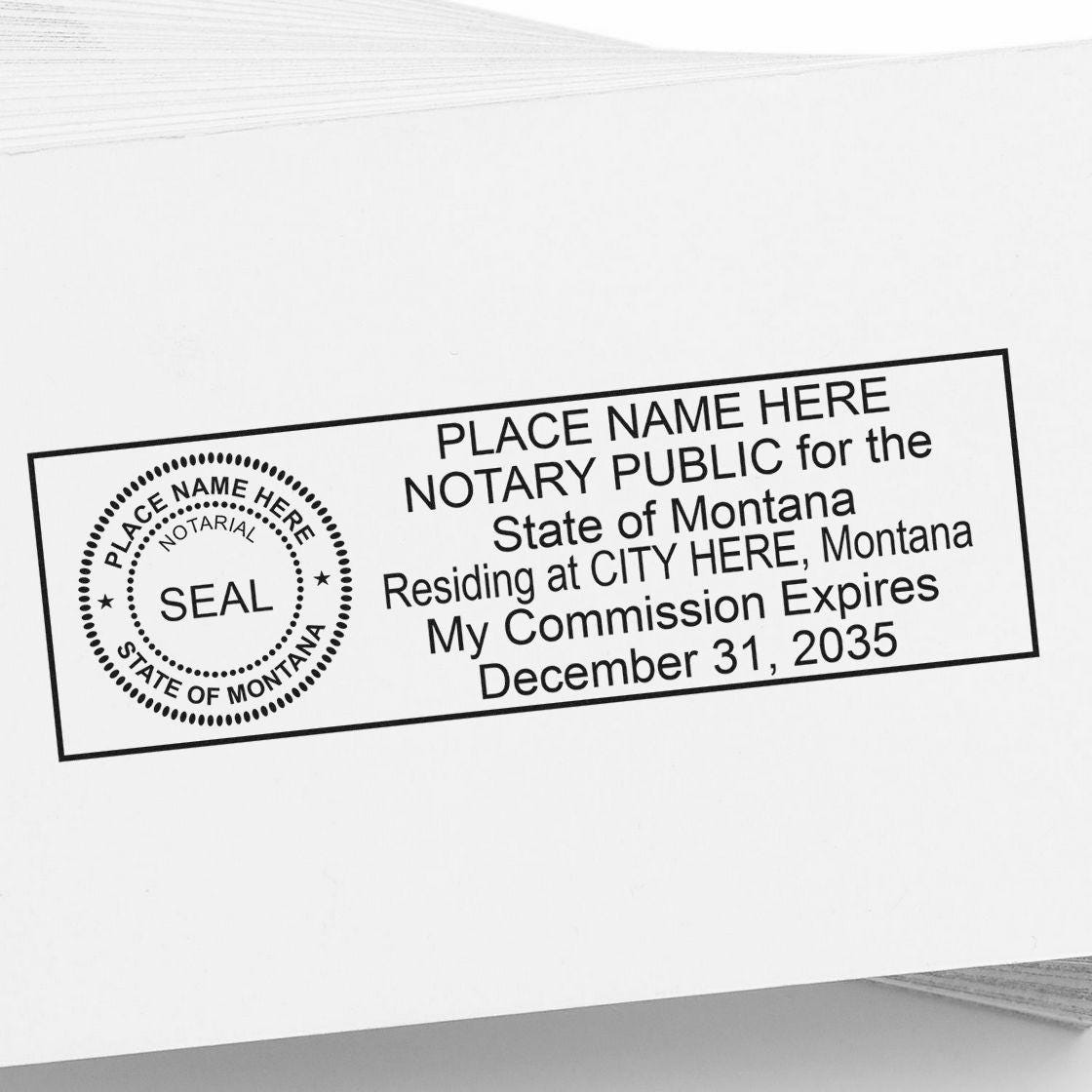
Understand the Role of a Montana Notary Seal
A Montana notary seal is more than just a symbol or a requirement. It is your official mark of authenticity on important documents ranging from legal contracts to real estate deeds. When you place your seal, you confirm that you have verified the identity of the signer, witnessed their signature, and followed Montana’s notarial laws. This seal helps deter fraud, protects the integrity of the paperwork, and reassures the public that the document is legitimate.
As a commissioned notary public in Montana, you fulfill an essential function within your community. You carry a responsibility to ensure that every signature you notarize meets state requirements. Your Montana notary seal is at the center of that responsibility. It needs to be clear, precise, and durable so every notarization remains valid for the life of the document. Choosing the right seal also helps you stay compliant with state regulations, save time on the job, and present a professional impression to your clients.
Different Types of Montana Notary Seals
Selecting the best Montana notary seal can initially feel complicated because every developer or supplier seems to offer multiple options. In reality, the choice depends on your personal preferences, work environment, and budget. Generally, notary seals fall into four common categories: traditional rubber stamp seals, pre-inked stamp seals, self-inking stamp seals, and embossing seals. Understanding these variations will help you determine which option gives you the clearest impression and the smoothest workflow.
Traditional Rubber Stamp Seals
Traditional rubber stamps use an external ink pad for each impression. If you lean toward simplicity in your notarial tools, you might appreciate how straightforward a rubber stamp feels. You simply press the stamp onto an ink pad, ensure even coverage, and then apply the stamp to the document.
- Advantages:
Typically cost-effective compared to other options.You can choose from a wide range of ink pad colors.Easy to replace or re-ink your pad without special supplies.
- Disadvantages:
Requires a separate ink pad, which can be cumbersome if you frequently travel.Risk of uneven stamping if you do not keep enough ink on the pad.May result in ink smudges if you press too lightly or too hard.Many Montana notaries still favor this classic option. However, if your daily tasks require heavy stamping, you might appreciate the convenience of a pre-inked or self-inking seal.
Pre-Inked Stamp Seals
Pre-inked stamps include the ink directly in the stamp’s internal reservoir, so you do not need an external pad. This design reduces the number of items you carry when traveling to meet clients. Because the ink is embedded in the stamp, you typically enjoy cleaner impressions. Also, you can often make thousands of stampings before needing to refresh the ink.
- Advantages:
Crisp, clean impressions with detailed lines and text.Long-lasting ink supply, ideal for high-volume notaries.Compact design since no separate ink pad is needed.
- Disadvantages:
More expensive up front than a traditional rubber stamp.Re-inking might require specific ink refills from the same manufacturer.Slower impression drying time in some cases.Pre-inked stamps can be an excellent choice if you notarize numerous documents each day and want a consistently sharp imprint.
Self-Inking Stamp Seals
Self-inking stamps have a built-in ink pad that automatically re-inks the stamp die between uses. When you press down, the die flips against the pad and then onto your document. Once you lift up, the die rotates back into the stamp body, re-inking itself for the next impression.
- Advantages:
Fast, convenient, and easy to handle.Delivers a uniform impression with each application.Fewer smudges and less risk of double stamping.
- Disadvantages:
Can dry out over time if not stored properly.Must purchase the correct ink to refill the built-in pad.Initial cost is higher than a basic rubber stamp.For busy notaries, self-inking stamps are popular because they simplify the stamping process and maintain a consistent ink level, making them well-suited for everyday notarial tasks.
Embossing Seals
An embossing seal leaves a raised, imprinted impression in the paper itself rather than relying solely on ink. Many Montana notaries prefer an embosser for a professional touch or to deter fraud attempts, raised impressions are much harder to replicate than inked stamps.
- Advantages:
Creates a distinctive, tamper-resistant seal.Adds a polished, official look to your notarized documents.Generally accepted by most state and local agencies.
- Disadvantages:
Embossed text can be harder to read if the paper is thin or overshadowed by other text.Might be inconvenient for large document stacks where the raised pattern can distort multiple pages.Can be more expensive than simple rubber stamps.Because Montana does not require embossers in every circumstance, you can use them to complement an inked seal or as your primary device if you meet state guidelines. However, double-check that your daily notarial duties align with the best practices for using embossers.
Key Factors for Choosing the Perfect Seal
After exploring the variants, how do you decide which Montana notary seal aligns with your needs? Consider these factors:
- Frequency of Use
If you notarize multiple documents a day, a self-inking or pre-inked stamp often outperforms a traditional rubber stamp. You can move quickly from one document to the next without juggling a separate ink pad.
- Required Clarity
Your seal imprint must always be legible. If a raised or embossed look appeals to you, or your state requires a clearly readable design, an embosser or high-resolution pre-inked stamp can offer sharp, clean lines.
- Portability
Do you work from multiple locations or offer mobile notary services? A compact stamp that stores easily in your briefcase or bag can prove invaluable. Self-inking and pre-inked stamps excel in portability.
- Budget Constraints
If you are on a tight budget, a traditional rubber stamp remains the most cost-friendly option. However, consider long-term costs like replacement ink pads. Self-inking or pre-inked stamps cost more initially but often pay off in convenience over time.
- Montana-Specific Requirements
Notaries in Montana should confirm whether the state imposes any size or format guidelines. Although Montana generally allows different seal styles, you want to ensure your chosen seal meets official regulations before purchasing.
Caring for and Using Your Seal Responsibly
Owning a Montana notary seal comes with responsibilities beyond simply purchasing it. You ensure every notarization complies with state rules. Your seal is a legal tool that demands safe handling and proper storage.
- Store your seal in a secure place
Keep your seal in a locked drawer or secure bag, especially if you offer mobile notary services. This prevents unauthorized use and maintains the integrity of your seal.
- Maintain ink levels
Check ink levels regularly. Avoid letting the ink run dry, which could result in faint or invalid impressions. Whether you choose a pre-inked or self-inking stamp, keep manufacturer-approved refills on hand.
- Protect embossed impressions
If you use an embosser, make sure your documents remain free from smudges or tears. Press firmly but gently, ensuring the paper retains a crisp impression without folding or wrinkling.
- Practice consistent stamping technique
Apply consistent pressure each time you stamp to produce clearly visible details. Inconsistent stamping can lead to partial impressions or smears. Take a moment to confirm each seal is readable before you move to the next page.
- Monitor seal wear and tear
All stamps wear out eventually. Pay attention to any distortion or fading of your notary seal impression over time. Plan to repair or replace your seal if it fails to produce a clear, compliant result.
Why Acorn Stamps Is a Great Choice
When you are in the market for a new Montana notary seal, you have more than a few options, but Acorn Stamps stands out for several reasons. They specialize in top-quality Montana notary stamps and notary seals for all levels of professional demand. Here are some of the benefits you can expect:
- Stellar Customer Service
Family owned and operated since 1964, Acorn Stamps builds lasting relationships with notaries by offering friendly, knowledgeable guidance on their products. They believe in making sure you feel confident about any stamp or seal you purchase.
- Super Fast Turnaround
Acorn Stamps understands that your time is precious. Whether you require a rubber stamp, a self-inking seal, or an embosser, they deliver promptly so you can continue your notarial duties without interruption.
- Experience and Reliability
With 60 years of service under their belt, Acorn Stamps knows the ins and outs of Montana's notary seal requirements. That expertise means you can expect customized recommendations based on the type of work you do.
- Variety of Options
From pre-inked to self-inking and embossing seals, they carry an assortment of sizes and formats. This variety ensures that you find exactly what fits your style. If you prefer a certain design or have unique requirements, they likely have the perfect product.
- Commitment to Quality
Cheap seals might seem tempting, but quality matters when you are dealing with legal documents. Acorn Stamps focuses on durable, professional-grade construction. This way, your seal remains sharp and consistent through thousands of uses.By selecting reliable tools from Acorn Stamps, you set your notarial business up for success. A dependable seal helps you establish a strong professional presence and reduces potential errors during notarizations.
Frequently Asked Questions
Can I Use Any Color Ink for My Montana Notary Seal?
Montana law does not specify an ink color, but it is wise to use a color that reproduces well when documents are scanned or photocopied, such as black or a dark blue. This ensures clear visibility and reduces the risk of your seal imprint becoming illegible in reproduced copies.
Is an Embossing Seal Required in Montana?
Montana does not strictly require an embosser. You may use an inked stamp, an embossing seal, or both. However, many notaries prefer the added security of an embosser since the raised impression can deter document tampering.
How Long Does a Typical Notary Stamp Last?
The lifespan of your stamp depends on how often you use it and how well you maintain it. Pre-inked and self-inking stamps can produce thousands of impressions before the ink needs refreshing. Traditional rubber stamps are limited only by the life of the separate ink pad, which you can replace easily.
Do I Need to Reregister My Seal if I Move Within Montana?
If you change your address, you are responsible for updating your notary information with the appropriate office. This does not necessarily mean you need a new seal, but you must ensure your official documentation and commission details remain current. Always confirm with Montana’s notary commissioning authority.
What Happens if My Seal Gets Damaged or Lost?
If your seal is lost, stolen, or damaged, it is critical to stop using it immediately. Notify the Montana Secretary of State’s office or the appropriate authority about the issue. You will likely need to obtain a replacement seal to continue notarizing documents. It is also a good idea to keep backup stamps and store them in a secure location.
Selecting the right Montana notary seal paired with proper care ensures that your notarial duties go smoothly and that every document you notarize meets Montana's legal requirements. When you invest in a reliable, high-quality seal—such as one from Acorn Stamps, you build confidence with your clients and help safeguard the legitimacy of the notarized documents you oversee. By staying informed, practicing secure stamping habits, and choosing the perfect seal design, you are ready to perform notarial responsibilities successfully wherever your journey takes you.